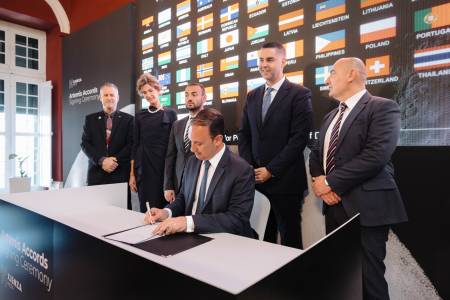
Malta has officially signed the Artemis Accords, joining a growing group of countries committed to shared rules for space exploration.
“Today, it’s my pleasure to welcome the Republic of Malta to the Artemis Accords community,” NASA Administrator Jared Isaacman said. “By joining this growing coalition, Malta affirms shared commitments to peaceful, transparent, and responsible space exploration. These commitments safeguard against chaos and confusion, and they chart a responsible path forward for every nation that dares to accomplish the near-impossible in space.”
Malta’s Minister for Education, Youth, Sports, Research and Innovation Clifton Grima signed the Artemis Accords on behalf of the country.
“Malta is taking a deliberate step to position itself within a high-value, innovation-driven global sector,” said Grima. “This initiative strengthens our governance framework, enhances Malta’s international credibility and creates new opportunities to attract investment, build expertise and generate quality employment within the space economy.”
Deputy Prime Minister Ian Borg said that, “in an era where geopolitics is increasingly shaped by technology and strategic competition beyond Earth, the Artemis Accords provide a common framework for responsible behavior, transparency and accountability among like-minded partners. By reaffirming respect for international law and fostering trust in cooperative space exploration, the Accords consolidate alliances and ensure that scientific progress is accompanied by diplomatic relevance and influence.”
The Artemis Accords were launched in 2020 by the NASA as part of the broader Artemis program.
They’re non-binding guidelines, not a treaty, and they build on existing space law like the Outer Space Treaty.
Their goal is to make sure space exploration is:
- Peaceful
- Transparent
- Cooperative
- Environmentally responsible (especially regarding space debris)
Countries that sign agree to:
- Share scientific data openly
- Register space objects and activities
- Help prevent space debris
- Ensure interoperability (countries’ tech can work together)
- Respect “safety zones” to avoid interference on the Moon and beyond
Why it matters for Malta
For Malta, this is less about launching rockets tomorrow and more about positioning itself in the global space economy:
- Signals alignment with major spacefaring nations
- Opens doors for research partnerships and funding
- Boosts credibility in science, tech, and innovation sectors
- Gives Maltese institutions a role in future space-related projects