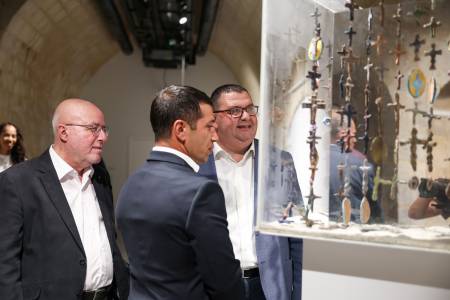
Minister for Home Affairs and Security Glenn Bedingfield stressed the importance of rehabilitation and reintegration into society during the opening of the exhibition ‘PRESON – Presence Beyond the Walls’ which is now open to the public at MUŻA, in Valletta.
The word PRESON is created from the words prison and person and reflects the central message of the exhibition: that behind every person in prison there is a human being, with a story, experiences, talents and potential. “Behind the prison walls there is a person,” said Minister Bedingfield, while emphasising that the fact that a person is serving a sentence should not mean that the person behind that sentence is lost.
The Minister said that the walls of a correctional facility may limit physical movement, but they should never limit creativity, education, human dignity and the possibility of change. “Prison should not only be a place where a person serves a sentence. It should also be a place where a person is given the opportunity to change and prepare for a different life,” said the Minister.
He explained that the Government’s vision for the correctional sector is one that combines security with rehabilitation, through investment in a more modern and secure correctional environment, but also in more opportunities for education, training and support for people serving sentences.
The Minister stressed that rehabilitation is not just about the time a person spends in prison, but also about what happens afterwards. “Rehabilitation does not end at the prison gate. It means giving a person the skills and support to rebuild their life, find opportunities and make different choices,” said Glenn Bedingfield. He also emphasised the important role of voluntary organisations and NGOs in this process, both during the time a person is in the correctional facility and during their reintegration into society.
Mario Cutajar, chairman of Heritage Malta said “This is a very interesting exhibition, an exhibition that achieves the goals of Muża. There are people behind the walls of Corradino, but with this exhibition it is clear that their thinking goes beyond those walls. They have brought out their feelings and what they love, this is what Muża is and what the Biennale was started for.”
The artistic works being exhibited at MUŻA are the result of an artistic and educational process that began within the Correctional Services Agency and continued through the Floating Fragments project at the Malta Biennale 2026.
Through this exhibition, the works are taking another important step as they leave the correctional environment and enter a national cultural space open to the public.
The Minister described this journey as one of particular significance: a work created by a person “inside”, within the walls of the prison, is now “outside”, in the heart of Valletta. He said that this exhibition shows in a concrete way how art can be a tool of education, reflection and expression, but above all it shows that a person’s past should not necessarily determine their future.
The Minister made it clear that this does not mean forgetting responsibility for the actions that have been carried out, but that society must believe in the possibility of change and rehabilitation. “A safe society is also a society that tries to reduce the risk of a person making the same mistakes again,” said the Minister, while reiterating the Government’s commitment to continue investing in people, in education, training and support.
At the end of his address, Minister Bedingfield thanked the people who created the artworks, the Correctional Services Agency, MUŻA and all those who contributed to making this exhibition a reality. “Today, these works have come out of the walls and with them an important message is emerging: behind the prison walls there is a person and every person should have the opportunity to learn, change, create and, ultimately, find their place in society again.”
Photos (MHS)