A package of legal reforms has been announced that will further modernise the Public Registry, strengthen its operations and improve the service provided to citizens. These changes are built on principles that focus on more dignity, less bureaucracy and lower costs for the public, while strengthening the administrative system of the Public Registry.
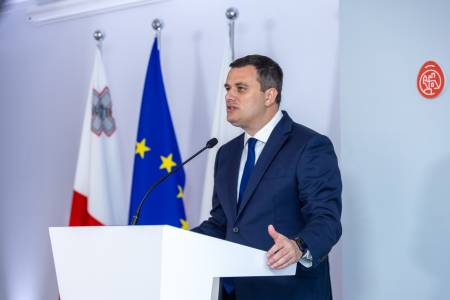
In his address, the Minister for Home Affairs, Security and Employment, Byron Camilleri, emphasised the thinking behind these changes: “When you are in politics, or in public administration, what you do should always have clear objectives that lead to the improvement of people’s lives and dignity. Sometimes things that may seem small make a big difference. Or you come across themes that may not affect thousands, but affect dozens or single people, but to that family, to that person you have made a big difference.”
Among the key changes is a clearer structure within the Public Registry, with a distinction between the Insinuations and Searches Section and the Civil Status Acts Section. Each section will be headed by a dedicated Director responsible for operations in Malta and Gozo, to ensure greater uniformity in processes and more effective strategic direction.
The reforms address situations that have been creating difficulties for several families, including the registration of births when the mother is not legally separated but married to another man who is not the child’s father. Through a new legal mechanism, biological parents will be able to register the child directly, with less bureaucracy and costs.
Another change concerns the choice of surname upon marriage, where the Government is removing the five-year limit for couples married before 2021 to change their surname without time restrictions.
The amendments also include new provisions on death certificates, so that in sensitive cases the cause of death is not publicly disclosed, while it remains officially registered. At the same time, inconsistencies in the area of adoption are being addressed to ensure proper recognition of biological parents, where there are cases where a natural parent appears in the act as an adoptive parent.
These reforms are accompanied by modernisation and digitalisation measures that will make life easier for people and businesses, including an electronic system for notarial deeds and a simplification of the process of registering property-related deeds, eliminating double payments and benefiting the public from a single fee. Notarial deeds can now be submitted electronically, through a portal that the agency is in the process of implementing. To date, and until this portal is completed, they have to be submitted in person. This also complements a service that has already been created in previous years where notaries receive searches electronically and securely. In fact, the first phase of the project is complete and notaries are receiving searches on wills and updates electronically. In the coming months, this will be extended to all types of research.
Other legal changes concern the characters and alphabet used. All acts, such as the birth certificate, must be prepared using the basic ISO Latin characters and Maltese characters. Transliterations must be provided for any details that use other character sets. Simply put, if you are going to register a birth in Malta you will use our language that comes from the Constitution. That is, the Maltese or English language and alphabet.
The Minister concluded by emphasizing that these reforms are part of a broader vision of a Government that continues to improve people’s lives. “These are changes, important reforms that respect the rights and dignity of the individual. Reforms that come from the fact that we do not rest on the status quo, and testify to how this Government does not stop when it comes to reforms that can improve people’s lives, in what they face every day. A sensitive Government that is here to assist you at every point of your life.”
The Chief Executive of the Identity Agency, Col. (ret) Dr Edric Zahra, stated that: “These amendments clearly show the direction in which the Identity Agency is moving, that of providing modern, flexible public services that reflect today’s realities. Among the main goals of the agency is to make people’s lives easier. These changes will mean simpler processes, lower costs and more accessible services for the public.”
Photo: MHSE