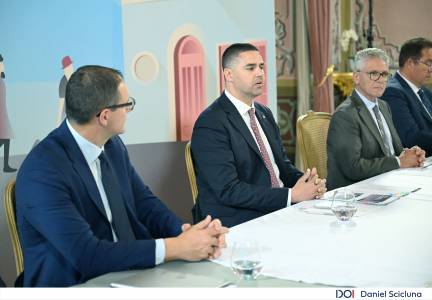
The Deputy Prime Minister and Minister for Foreign Affairs and Tourism, Ian Borg, announced new regulations to improve the quality of all types of tourism accommodation, including hotels, boutique hotels and short-term rental properties.
The Tourism Accommodation Regulations 2026 were published on Wednesday under the Malta Travel and Tourism Services Act. They are replacing and consolidating four existing subsidiary legislations targeting different types of tourist accommodations.
“The new regulations will close enforcement gaps and align existing regulations with the Maltese Islands’ strategic shift towards a higher-value tourism offering, while safeguarding the wellbeing of local communities,” Dr Borg explained.
“Tourism is the cornerstone of our economy. Securing its future demands bold, responsible decisions and a clear direction for future investment. This is exactly what we are doing through these regulations, which will raise standards across all accommodation categories, ensuring that we continue to meet and exceed our visitors’ expectations,” he said.
Among other changes, owners or operators of short-term rentals will now be required to affix a sign outside the property entrance, including the licence number and the name and contact number of a designated person available 24/7 to receive complaints and tackle related issues. In the case of properties forming part of a condominium, as soon as owners are issued with a short-let licence from the Malta Tourism Authority, they will be obliged to provide this information to the residential block administrators as well.
Short-let accommodations will also need to submit and implement an adequate waste collection management plan, among other related requirements. Owners caught operating short-let accommodations without a valid Malta Tourism Authority (MTA) licence will now be liable to a three-year disqualification, besides other applicable penalties.
The new regulations announced on Wednesday also introduce updated requirements for new hotel developments and existing hotel redevelopments and extensions, as well as other collective accommodation establishments, including guest houses and boutique hotels, encouraging investors to focus on superior levels of service, rather than volume.
Tourism authorities will no longer consider new hotels or extensions that exceed height limitations
The MTA will no longer favourably consider applications for new hotels or existing hotel extensions and redevelopments that exceed the maximum permitted height established in the relevant Local Plan Height Limitation Maps or Development Briefs.
New hotels, extensions or redevelopments with more than 200 rooms and hotels with a rating lower than three-star will also not be considered. Similarly, guest houses, at a maximum of 20 rooms, will only be considered if they are located in Urban Conservation Areas, in Scheduled Buildings or in buildings with distinctive architectural features, and only if the development will preserve the property’s architectural heritage.
The regulations are also placing increased emphasis on the sensitive restoration and repurposing of heritage buildings for high-quality tourism accommodation, through the Heritage Label and the new Diffuso Label, which allows hotels or guest houses to operate across multiple converted buildings located within the same Urban Conservation Area, close to a central building housing the main facilities. The MTA will allow three-star, four-star and five-star hotels and guest houses to be promoted as “heritage hotels”, as long as their building is certified to have a historical importance by the relevant authorities, and only when their distinctive heritage features have been adequately preserved.
Boutique & Luxury Boutique Labels are also being included in Maltese legislation for the first time, encouraging further investments in these upscale accommodations.
The new regulations were finalised following an extensive stakeholder consultation process, including a month-long consultation period last November, yielding more than 260 responses, as well as engagement with industry representatives, government entities, local councils and other interested parties. Two webinars were also held in collaboration with the Chamber of SMEs and the Gozo Regional Development Authority.