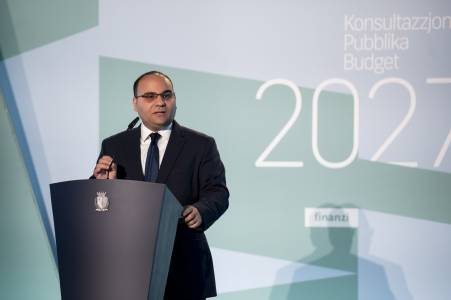
“In a few months, energy prices have risen significantly. But in our country, fuel, electricity and gas prices have not seen any change. No other country is doing what we are doing. Malta is the only country that has continued to protect families and businesses from these heavy burdens.” This was the main message of Finance Minister Clyde Caruana during the launch of the pre-Budget document for the year 2027.
He explained that although energy and food subsidies had decreased from €242.5 million in 2023 to €188.1 million in 2025, they are expected to rise significantly to €391.7 million in 2026, due to ongoing geopolitical tensions around the world.
For the year 2027, subsidies are estimated to reach another €400 million. To this must also be added €75 million in investment in energy infrastructure.
Minister Caruana compared fuel prices in our country with Malta’s closest country, Sicily. He explained that although this country is a stone’s throw away from us, the price of diesel is almost double the price in Malta, while the price of petrol is 60% higher than in Malta.
“In the last five years, this Government has spent no less than €1.35 billion in energy subsidies. We are doing all this because we were wise and our country’s finances are strong. If the country’s finances were not strong, we would not be in a position to provide all this assistance,” the Minister continued.
Without subsidies, the Maltese economy would suffer from long-term repercussions while jobs in our country would decrease and unemployment would increase.
He said that although this is a challenging time, the Government will continue to offer stability in this area to protect Maltese and Gozitan consumers and at the same time maintain economic stability.
He explained that the Maltese economy is expected to grow at a rate of 3.7% in 2026, the highest growth forecast among all European Union Member States. This rate far exceeds the European Union average of 1.1% and the Eurozone average of 0.9%.
The labour market participation rate in our country also exceeds that of the European Union, with a strong rate of 82.6% in 2025 compared to the European Union average of 75.6%. Our country also has the highest employment rate in the EU, with a rate of 84.0% in the second quarter of 2026, compared to the European average of 76.4%.
Minister Caruana said that the unemployment rate in Malta is among the lowest in the European Union, with a rate of 3.5% recorded in July 2026, compared to the EU average of 6.1% and the Eurozone average of 6.4%.
Inflation in Malta has remained moderate over the last twelve months, with a rate of 2.1% recorded in July 2026, well below the European Union average of 3.0% and the Eurozone average of 2.9%.
Fiscal sustainability will remain a key priority in the coming years. In recent years, Malta’s deficit has declined from 3.4% in 2024 to 2.2% in 2025, while for 2026 it is projected to be 2.8% of GDP and remain below the 3.0% limit set by the European Commission.
For 2025, the general government debt rate was 46.4%, and the European Commission is forecasting that this rate will remain stable at around 46.0% in 2026, well below the EU average and the limit set by the European Commission, that of 60%.
The document is accessible on the Ministry for Finance website finanzi.gov.mt .
Photo: MFF