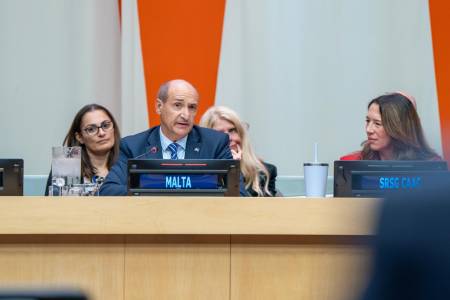
Malta led a high-level meeting at the United Nations in New York on the protection of children in armed conflict, with a particular focus on the devastating impact of explosive weapons in populated areas and the challenges posed by new and evolving technologies in warfare.
The meeting, organized by the Permanent Mission of Malta in New York together with UNICEF, War Child Alliance and the Office of the Special Representative of the Secretary-General for Children and Armed Conflict, was held to mark the 30th anniversary of the establishment of the United Nations mandate on Children and Armed Conflict.
During the meeting, Minister for Foreign and European Affairs Chris Fearne stressed that the protection of children must remain at the heart of international efforts for peace and security. In 2025, the United Nations verified more than 14,200 cases of children killed or injured in conflicts, with explosive weapons and explosive remnants of war remaining among the leading causes of child casualties.
“I spent a large part of my life as a pediatric surgeon, working to save lives and protect the future of the most vulnerable. Behind every number is a face, a family, a dream and a future taken away. These are not simply statistics; they are innocent lives cut short,” Minister Fearne said.
The discussion focused in particular on the use of explosive weapons in populated areas. Beyond killing and injuring children, these weapons can destroy schools, hospitals and essential services, leaving communities to deal with their consequences for years. Malta is among the 91 countries that have endorsed the Political Declaration on Explosive Weapons in Populated Areas, which seeks to reduce harm to civilians.
Minister Fearne also addressed how drones, autonomous systems and military applications of artificial intelligence are changing the way conflicts are fought. He stressed that human oversight, accountability and respect for international humanitarian law must remain fundamental as these technologies continue to develop.
“If, as human beings, we are still unable to stop wars, then the very least we can do is protect innocent children. Every child deserves to live in safety, grow up in peace and have a future,” Minister Fearne concluded.
Photo: MFEA