New Financial Assistance Service for people suffering damage due to construction works
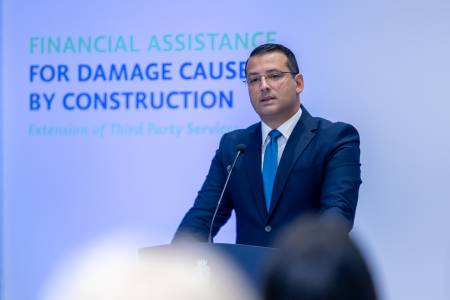
Minister for Infrastructure, Planning and Employment Jonathan Attard has announced the introduction of a new Financial Assistance service that will offer stronger protection to people who suffer property damage due to construction activity. This measure, which fulfils another election promise in the first hundred days of the legislature, will come into effect from 1 November.
During a press conference, Minister Attard explained that the reform continues to strengthen the principle that development should be carried out responsibly and that when damage is caused, those who have suffered it should be given effective, fair and timely redress.
Through the new service, persons who have not reached an agreement with the developer or contractor involved will be able to submit a claim to the Building and Construction Authority (BCA). After assessing the facts and determining liability, the BCA will be able to make financial compensation for the damage caused, while subsequently recovering the costs from the person responsible, together with interest due.
Minister Attard also announced that every BCA clearance issued from 1 November onwards will be covered by this new framework, so that citizens affected by damages related to construction works can benefit from the protection offered by this mechanism.
Dr Attard explained how this measure addresses an imbalance that has existed for many years, where residents affected by damage often had to bear substantial costs and engage in lengthy procedures to seek redress.
“We are creating a system where the citizen is not left alone in the face of a problem that he did not cause,” the Minister said.
The reform also includes the conversion of the existing bank guarantee into a more effective protection mechanism. While an independent study conducted by Grant Thornton identified limitations in the current system, the new framework will transform a passive guarantee into an active one that can intervene directly in favour of affected persons.
The Minister stressed that this is not a Government or taxpayer fund, but a reserve financed by the industry and each applicant, through contributions related to BCA clearance applications. This will strengthen the protection of citizens without creating new burdens on public finances or on consumers.
Dr Attard pointed out that the initiative forms part of a wider reform of the construction sector, which over recent years has led to the strengthening of the BCA, the introduction of a licensing framework for operators, work on the National Building and Construction Code, the development of the Skills Card and new assistance services for citizens.
He also explained that an international comparative study found that the Maltese model will be among the most advanced systems in protecting people affected by construction activity, by combining under one framework assistance services, free professional support, compensation mechanisms and recovery powers by the Authority.
“This is an initiative that complements and strengthens the recommendations made over the past few years, including those that emerged from the Sofia Public Inquiry. But at the same time it is also a clear example of our commitment not to limit ourselves to the implementation of recommendations alone. Where we saw the need to go one step further to strengthen the protection of the citizen, we did so,” stressed Minister Attard.
He claimed that this measure is not against construction but in favour of more responsible construction, more accountability and more protection for residents.
“From November 1, a person who suffers damage due to construction will not be left alone. They will find an Authority that listens to them, a system that helps them and a Government that is on their side,” concluded Dr Attard.
For his part, the Authority’s Chief Executive, Architect Roderick Bonnici, explained how this service will operate. After an agreement is not reached between the third party and the developer regarding alleged damages in connection with a construction development, the same third party makes a claim to the Authority. The Authority, for its part, through an Architect, verifies that these damages are truly caused by construction work, and the same claim is brought before a Committee which approves the claim with a maximum of €15,000.
“This service will be divided into four main steps which are: the cessation of works and the Authority intervenes immediately as an intermediary while an assessment is made by the BCA of the damages; the second step, a request is made to the Reserve Committee which in turn approves the request with a maximum of €15,000; the third step, a contract is signed between the BCA and a 50% payment is made before the works begin; the fourth step will then be for the BCA to collect the money issued from the developer,” explained Architect Bonnici.
Meanwhile, Architect Bonnici explained that until today, the Building and Construction Authority did not accept application fees, however with legal amendments that have been made, from the 1st of November, every developer must start paying in order to process their application and support this reserve that has been created for the purpose of this new service. The contributions that must be made with the application reflect the banking costs related to the maintenance of the bank guarantee as it stands today.
Present for this conference were the Permanent Secretary within the Ministry, Mr. Ronald Mizzi, the Chairman of the BCA Board, Architect Simon Saliba and a number of stakeholders in the Construction sector.
Photo: MIPE