As ongoing geopolitical uncertainties continue to disrupt global markets, resilience, diversification and diplomacy are central to ensuring Malta’s economic security.
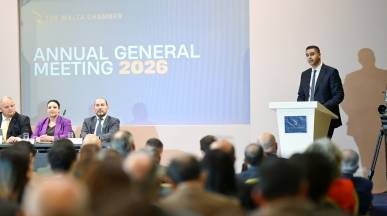
On Monday, Deputy Prime Minister and Minister for Foreign Affairs and Tourism, Ian Borg, addressed the Annual General Meeting of the Malta Chamber of Commerce, Enterprise and Industry, in Valletta, discussing the implications of global instability on Malta’s trade and economic development.
The war in Ukraine, the conflicts in the Middle East and the Gulf, and increasing competition over critical technologies and supply chains, are reshaping global commerce, disrupting trade routes, and placing new pressures on all nations. Faced with this reality, Malta must prioritise resilience, diversification and diplomacy, objectives that are also central to Malta’s long-term vision, towards an economy capable of withstanding shocks and seizing opportunities.
To ensure resilience, Malta must continue investing in “preparedness, efficient logistics and secure connectivity to global markets,” Dr Borg explained, as he emphasised the need to diversify outward while consolidating existing strengths. “Diversification is essential to expand markets and build resilience. Malta must strengthen its European base while deepening engagement in the Mediterranean, the Gulf, Africa, and emerging economies, ensuring reduced dependence on any single geopolitical sphere,” said Dr Borg.
The Deputy Prime Minister encouraged all stakeholders to keep protecting what already works, including financial services, digital industries, maritime, aviation, tourism and advanced manufacturing. “These sectors employ thousands and contribute significantly to national wealth, and we must ensure they retain their competitiveness and sound regulation. Stability and predictability remain key to investor confidence, and we are committed to providing both,” he affirmed.
Economic diplomacy and multilateral engagement are critical as well. As he outlined the efforts of Malta’s diplomatic network in supporting businesses abroad, Dr Borg noted that “for small states like Malta, multilateral fora are our first line of defence. Through engagement in international and regional organisations, Malta works to uphold fairness, openness, and predictability in global trade.”
He also highlighted the importance of strategic foresight. “Change is rapid and demands anticipation rather than reaction. This requires strong collaboration between the government, business, and our diplomatic network, alongside sustained investment in skills, innovation, and digital transformation,” he added.
In this regard, Dr Borg commended Trade Malta, established through a collaboration between the Government and the Malta Chamber, for its efforts to support export promotion, training, market intelligence, and trade missions. “Together with our embassies, we will strengthen our support to ensure Maltese businesses can succeed internationally,” he said.
The Deputy Prime Minister also praised the Malta Chamber, which continues to be an invaluable partner in promoting competitiveness, good governance, and responsible leadership. “Malta’s future depends on remaining outward-looking, innovative, and resilient. Our entrepreneurs have already proven their ability to compete globally. As a Government, we will continue providing the conditions for success through stable policy, strong partnerships, and a diplomatic network aligned with the private sector,” concluded Dr Borg.
Photo: MFT