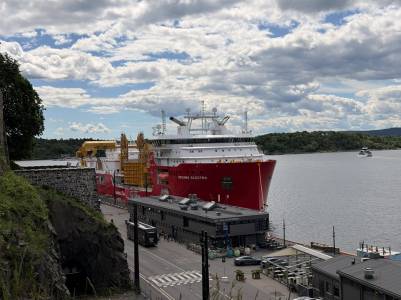
The launch of the maritime vessel Nexans Electra, together with progress achieved on IC2 to date, represents a further milestone in the delivery of this critical infrastructure project
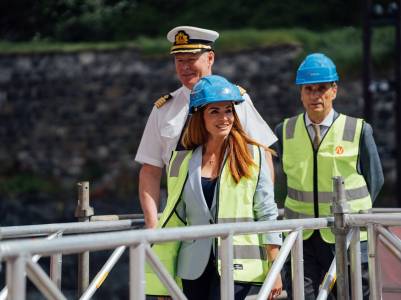
Energy Minister Miriam Dalli participated in the official launch of the cable-laying vessel Nexans Electra in Norway, a key asset that will be deployed in the offshore installation of Malta’s second electricity interconnector (IC2) with Italy.
Also present for the inauguration were representatives from InterConnect Malta and Nexans.
The event marks an important milestone in the implementation of the IC2 project, which will further strengthen Malta’s energy infrastructure and its connection to the European electricity network.
“The IC2 project builds on the experience of the first Malta–Sicily interconnector, commissioned in 2015 and delivered by Nexans. The second interconnector will be routed at a safe distance from the existing cable to enhance resilience and reduce the risk of simultaneous disruption. Once operational, the project will significantly reinforce Malta’s electricity system by providing redundancy, improving reliability, and supporting long-term demand growth. It is a key component of Malta’s strategy to achieve its 2030 climate and energy targets and longer-term decarbonisation objectives,” Minister Miriam Dalli stated.
Nexans, the contractor responsible for the manufacture, installation, and protection of the subsea cable, has completed the production and testing of the full 103 km cable length, including approximately 4 kilometres of spare cable. Manufacturing was carried out at Nexans’ high-voltage subsea cable facility in Charleston, United States, with manufacturing works commencing in August 2025. The offshore laying is expected to take place later this year, with Nexans Electra scheduled to mobilise to Charleston to load the cable before proceeding to Malta for the installation works.
The Nexans Electra is a state-of-the-art DP3 cable-laying vessel designed for the transport, installation, protection, and repair of subsea power cables. Measuring approximately 150 metres in length and equipped with multiple turntables, the vessel can carry and lay long cable sections within a single campaign.
Its advanced dynamic positioning system allows the vessel to maintain precise positioning without anchors, supporting safe and accurate installation in challenging offshore conditions and at depths of up to 160 metres along the IC2 route. Its capacity enables the entire subsea cable, weighing over 8 million kilograms, to be transported in a single voyage. The cable will be laid in two main sections, connected by one offshore joint, with cable burial carried out alongside the laying operations. Where trenching is not possible, specialised contractor Van Oord will provide additional protection through rock installation.
Recent offshore preparatory works have included a comprehensive survey and clearance operation along the cable route, during which unexploded wartime objects were safely removed, paving the way for the installation phase.
Parallel works are also progressing onshore. In Malta, 97% of the trenching works have been completed and the horizontal directional drilling (HDD) works at Magħtab are ongoing to facilitate the cable’s land–sea transition while minimising environmental impact. In Sicily, works are advancing steadily, with approximately 90% of trenching and 65% of cable-laying completed along the 21.7 km land route.
The project also considers the operational phase, with measures included for the procurement and storage of spare cable at the Delimara Power Station. Inġ. Ismail D’Amato stated that “the IC2 project also includes the installation of a dedicated turntable at Delimara for the storage of spare cable. This provision is strategically significant, as it ensures rapid availability of spare cable in the event of future repairs, reducing potential downtime and enhancing overall system resilience.”
This €300 million investment has been approved for ERDF funding under the priority “Promoting a clean and just energy transition” and contributes directly to smart and stable energy systems. The project has been recognised as an “Operation of Strategic Importance” in the 2021–2027 Programme, with €261 million allocated in European funding.