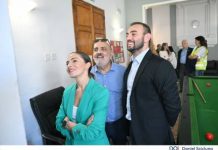
European Commissioner Jessika Roswall, who is responsible for Environment, Water Resilience and a Competitive Circular Economy, commended Malta’s investments in water infrastructure, acknowledging the island’s innovation in water management.
“It was a great opportunity to see how different types of water management come together and address the water demands of the island. This link is important for the Maltese and for Europe, as we have to step up our endeavours together to invest in water resilience,” the Commissioner said.
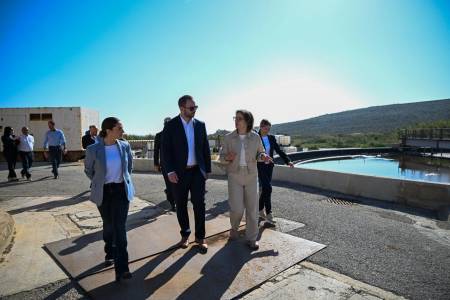
Accompanied by Minister for the Environment, Energy and Public Cleanliness Miriam Dalli and Water Services Corporation CEO Karl Cilia, Commissioner Roswall toured a number of investments Malta is making in water and wastewater infrastructure, aligned with the priorities of the EU Water Resilience Strategy.
“With an investment of over €370 million, the Water Services Corporation is planning to prepare our country for the future—supported in part by European Union funds. Together with the European Commissioner for the Environment, we discussed how to ensure that the water sector becomes more resilient. This is the path we must continue to follow, because I firmly believe that this small island can serve as an example to many others,” Minister Dalli said.
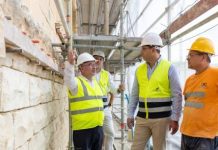
At the Ċumnija Sewage Treatment Plant in Mellieħa, the WSC explained how a €33.15 million investment is in the process to upgrade the plant. The project is now advancing through its design phase, with construction set to commence in the coming months. The project will ensure cleaner, quieter, and more efficient operations at Iċ-Ċumnija.
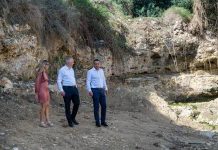
Commissioner Roswall also visited the Ta’ Bakkja groundwater gallery, one of Malta’s most significant and least visible water assets. Situated at approximately 100 metres below ground level, the gallery system serves as a gateway to six intricate water tunnels.
From these tunnels, WSC picks up around six percent of all groundwater, which is then mixed with reverse osmosis water before being delivered to consumers across the Maltese Islands. The visit highlighted the enduring strategic value of Malta’s natural aquifer system and WSC’s commitment to protecting and sustainably managing this resource.
At the Għar Lapsi Reverse Osmosis Plant, where Commissioner Roswall was shown the recently commissioned solar installation that now powers part of the plant’s operations. The €600,000 project, financed through Green Bonds, covers a roof area of 3,300 square metres and comprises 888 photovoltaic panels with a total capacity of 515 kWp.
Photo: MEEC