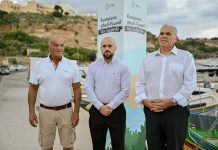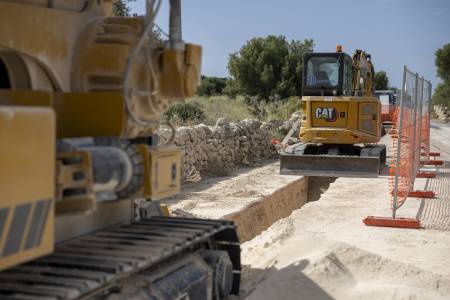
Interconnect Malta (ICM) announces another important milestone in the development of the Second Interconnector Project (IC2), with the completion of the land cable installation works between the Magħtab Terminal Station and the landfall transition joint bay, where the onshore cable system will connect to the submarine cable.
Almost 6km of high-voltage single-core cables have now been successfully laid between the Magħtab Terminal Station and the landfall transition joint bay, marking substantial progress in the onshore section of the project. Concurrently, the termination of the land cables within the Magħtab Terminal Station has also been completed both on the 120MVAr reactor and on the 250MVA 220kV/132kV transformer, with all the nine terminations completed.
“The steady progress being achieved on IC2 reflects our continued commitment to delivering the objectives set out in Malta’s Energy Shift: A Sustainable Power Transition. The second interconnector is a central component of this strategy, enhancing security of supply, increasing the resilience and flexibility of our electricity system, and creating additional capacity to accommodate renewable energy sources. The
completion of the onshore cable-laying works in Malta represents another significant step forward” said Minister for Energy, the Environment and the Regeneration of the Grand Harbour, Dr Miriam Dalli.
The project is set to reach another important milestone next week, when the final cable joint on Maltese territory is scheduled to be completed. This will conclude all land cable jointing works in Malta and ensure readiness for the connection of the onshore cable system to the submarine cable during the next phase of the project.
Once the remaining onshore works are completed, the onshore infrastructure will be fully prepared for integration with the subsea cable. Preparations for the marine cable laying phase are progressing, with the submarine cable laying operations targeted to begin towards the end of the year once the Horizontal Direction Drilling is completed in both countries.
The completion of the land cable installation and termination works represents a critical step in the delivery of the IC2 project. When operational, the IC2 will further strengthen Malta’s electricity connection with mainland Europe, enhancing security of supply, increasing system resilience, and providing additional flexibility to support Malta’s long-term energy transition objectives.
Interconnect Malta Divisional Manager, Dr Ing. Joseph Vassallo said: “The successful laying of almost 6km of land cable installation, together with the cable termination works at the Magħtab Terminal Station reflects the close coordination and technical expertise of all the parties involved in this project. These important milestones provide a solid foundation for the offshore installation phase planned for later this
year and bring ICM another step closer to completing this strategic national investment.”
Information about IC2 an EU Funded Project
The project consists of a new 122km long 245kV, 225MW, 50Hz electrical cable interconnection between Malta (Maghtab) and Sicily (Ragusa) to be laid in parallel but at a safe distance to the existing HVAC cable link which was commissioned in 2015.
This €300 million project was approved for ERDF funding, specifically under Priority 2, ‘Promoting clean and fair energy transition, sustainable wastewater management, and green investment’, and Specific Objective 2.3, ‘Developing smart energy systems, grids, and storage outside the TEN-E network’.
The second interconnector will not only increase the security of the electrical supply but will also lead to increased investment in renewable energy, which will help Malta better handle the intermittent nature of green sources like offshore wind and solar. Once completed, the 245kV submarine cable will double Malta’s connectivity to the European energy grid. According to the project’s cost-benefit analysis, 13.5
million tonnes of CO2 emissions will be reduced, enhancing its significance in Malta’s long-term decarbonisation strategy.
This €300 million investment has been approved for ERDF funding under the priority “Promoting a clean and just energy transition” and contributes directly to smart and stable energy systems. The project has been recognised as an “Operation of Strategic Importance” in the 2021–2027 Programme, with €261 million allocated in European funding.
More information can be found at: https://icm.mt/projects/