The second interconnector reaches another major milestone with the arrival, transportation and installation of key electrical equipment, including an auto transformer and shunt reactors, in both Malta and Sicily.
Complex heavy-lift and transport operations underway involving the movement of exceptionally large electrical assets through close coordination between contractors, engineers and authorities.
The Malta–Sicily Interconnector 2 (IC2) project has reached another significant milestone with the arrival, transportation and installation of the project’s auto transformer and shunt reactors in both Malta and Ragusa, Sicily.
Operations commenced in Pozzallo, Sicily, on 16 July, when the 240MVAr Shunt Reactor and associated accessories were discharged from the transport vessel. During the following night.
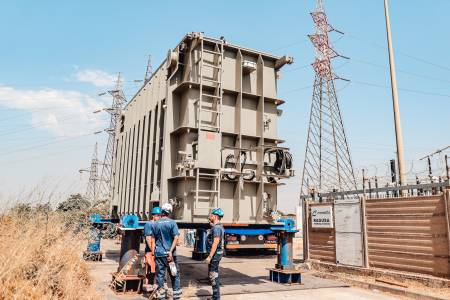
The Shunt Reactor was transported from Pozzallo Port to the project site in Ragusa, where major installation works commenced shortly afterwards. These include the transfer of the reactor from a modular trailer to a self-propelled modular transporter (SPMT), manoeuvring the
equipment into the substation and accurately positioning it onto its permanent foundation.
“This achievement marks another important milestone in the delivery of the IC2. The successful delivery of the auto transformer and shunt reactors in both Malta and Sicily represents a key step towards the completion of the interconnection infrastructure and prepares the ground for the next phase of works. As a strategic national investment, IC2 will strengthen Malta’s security of electricity supply, enhance network resilience, support the integration of renewable energy sources, and contribute to the country’s long-term energy and sustainability objectives.” Energy Minister Dr Miriam Dalli stated.
In Malta, the unloading and transport of the project’s 120MVAr Shunt Reactor and related ancillary equipment was also completed. In close collaboration with Transport Malta, the 250MVA Auto Transformer was also transported to site. Positioning and installation activities for
both units are scheduled to continue this week.
“These operations involve the movement and installation of exceptionally large and heavy electrical assets and require extensive planning and coordination between specialised transport contractors, heavy-lift operators, engineers, port authorities, transport authorities and other
stakeholders to ensure that every stage is carried out safely and efficiently. We are grateful to all authorities and stakeholders involved for their support and collaboration in facilitating these challenging operations safely and successfully.” Inġ Noel Darmanin, Executive at Interconnect Malta, commented.
Once commissioned, the second interconnector will strengthen Malta’s security of electricity supply, enhance the resilience of the national electricity network, increase interconnection capacity with the European grid, and facilitate the country’s continued transition towards a
cleaner and more sustainable energy system.
Information about IC2 an EU Funded Project
The project consists of a new 122km long 245kV, 225MW, 50Hz electrical cable interconnection between Malta (Maghtab) and Sicily (Ragusa) to be laid in parallel but at a safe distance to the existing HVAC cable link which was commissioned in 2015.
This €300 million project was approved for ERDF funding, specifically under Priority 2, ‘Promoting clean and fair energy transition, sustainable wastewater management, and green investment’, and Specific Objective 2.3, ‘Developing smart energy systems, grids, and storage outside the TEN-E network’.
The second interconnector will not only increase the security of the electrical supply but will also lead to increased investment in renewable energy, which will help Malta better handle the intermittent nature of green sources like offshore wind and solar. Once completed, the 245kV
submarine cable will double Malta’s connectivity to the European energy grid. According to the project’s cost-benefit analysis, 13.5 million tonnes of CO2 emissions will be reduced, enhancing its significance in Malta’s long-term decarbonisation strategy.
This €300 million investment has been approved for ERDF funding under the priority “Promoting a clean and just energy transition” and contributes directly to smart and stable energy systems.
The project has been recognised as an “Operation of Strategic Importance” in the 2021–2027 Programme, with €261 million allocated in European funding.
More information can be found at: https://icm.mt/projects/