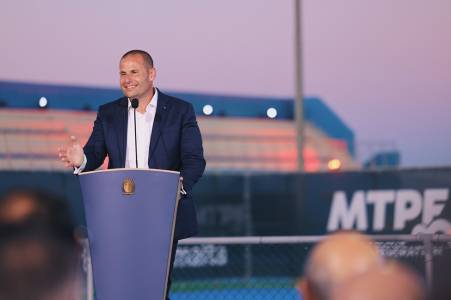
During the official inauguration of the National Tennis Center in Pembroke, Prime Minister Robert Abela described this project as another major sports investment in a discipline that had long required serious and adequate investment.
With an investment of €2.8 million, the official opening of the National Tennis Center in Pembroke marks another important step in the Government’s work to continue strengthening sports infrastructure in our country. This project has not only transformed an abandoned site into a modern, high-level facility, but is also giving fresh momentum to the development of tennis in Malta.
The project was carried out under the leadership of SportMalta, which worked closely with the Malta Tennis Padel Federation. This collaboration was crucial in ensuring that the facility meets the highest standards and addresses the needs of both athletes and the organizations involved in the development of tennis in Malta.
The center includes six tennis courts equipped with an ITF-approved Greenset playing surface, similar to that used at the Australian Open, as well as high-quality LED lighting on each court. In addition, the facility offers adequate space for spectators. The center also includes various facilities, including a physiotherapy room, dedicated spaces for athletes, and offices for the Federation.
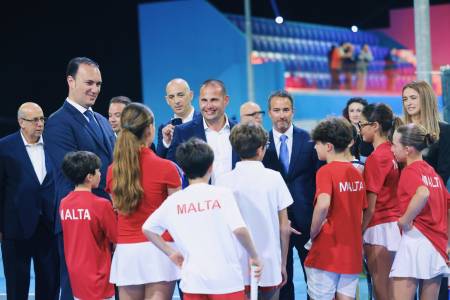
The Prime Minister noted that in recent years the sport of tennis has made significant progress, among which are the results Malta has managed to achieve at the Games of the Small States of Europe. “It is enough to say that in the last two editions of these Games we won no less than ten medals in tennis, three of them gold,” said Dr. Abela.
He explained how this investment continues to strengthen the national sports infrastructure and complements other projects such as the Basketball Pavilion at Ta’ Qali, the athletics track in Marsa, the Marsa Sports Complex, as well as the Gozo Indoor Sports & Aquatic Pavilion in Rabat, Gozo, which includes an Olympic-size swimming pool.
Dr. Abela also mentioned the work underway on other projects, including the first phase of the Ħal Far Track, which is expected to be completed in the coming months. He stressed that these projects are being made possible thanks to our strong-performing economy.
The Prime Minister also referred to various measures introduced by the Government to encourage a healthier lifestyle, including the six months free gym membership for youths and fiscal incentives for professional athletes.
The Minister for Education, Sport, Youth, Research and Innovation, Clifton Grima, said that the National Tennis Center is a clear example of how an abandoned space can be transformed into a modern, high-level facility that truly makes a difference in the lives of athletes and the sporting community. “Through substantial investment and close collaboration with the Malta Tennis Padel Federation, we are giving our athletes the tools and infrastructure they deserve in order to develop and reach their potential,” Minister Grima said.
He added that this project is not only creating a new space for tennis in Malta but is also demonstrating the Government’s commitment to continue investing in sport as a means of personal growth, health, and opportunities for present and future generations.
The Chief Executive Officer of SportMalta, Mark Cutajar, said that SportMalta is proud to continue supporting the sports community with high-level facilities. He said this is another example of how a government entity works hand in hand with a federation for mutual benefit.
The President of the Malta Tennis Padel Federation, Marc Gingell Littlejohn, described this investment as a historic step for the development of tennis and padel in Malta, with a state-of-the-art facility that became a reality thanks to the support of the Ministry through SportMalta.
He explained that this center will serve as a key hub for the training of national athletes, while also creating opportunities for exchanges with foreign players and preparation for international tournaments. He added that the facility will also help clubs organize more tournaments and activities, while supporting initiatives in schools to identify new talent and promote the sport through joint work with the National Sports School.
Photos: DOI/OPM