With the rebuilding of the Dun Karm Scerri Primary School in Naxxar, Maria Regina College, the students and educators at this school will have a new, modern environment equipped with the latest technology for their educational path.
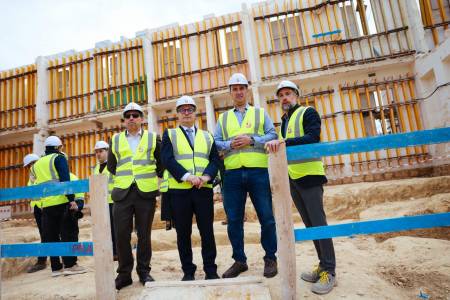
“This is another project that joins the previous ones, through which we are transforming the educational infrastructural environment. In this building we have kept the facade due to its characteristics, however inside we are building a completely new school,” explained the Minister for Education, Sports, Youth, Research and Innovation Clifton Grima when he visited the work being carried out together with the Minister for European Funds and the Implementation of the Electoral Programme Stefan Zrinzo Azzopardi this morning.
The first phase of the project includes construction work on the school building, as the existing building is being demolished. While the old school was spread over two floors, the new building will be over five floors, with two floors underground for ancillary purposes and three above street level. As the existing facade will be maintained, the new floor will have a design that respects the existing facade, however the new part will be built with contemporary materials to distinguish between the new and the old.
The new school will have 46 classrooms, including 20 kindergarten classrooms. It will also have a number of subject-specific classrooms including art, music, drama and industrial cooking. The new building will also have sports facilities, recreational spaces, a multi-sensory room, and a multipurpose hall. The school will also have a library that can be opened to the community after school hours.
The circulation spaces are designed to create spaces in which students can spend recreational time or be used by educators for more informal learning, thus making full use of every space in the school. A green fingers space will be created on the school roof so that students can have direct experience in caring for trees and plants.
After the construction phase, work continues, including the installation of services, including electricity, water and sewage, internet connectivity, alarms and security cameras, and other services including those related to fire safety. Work continues with the installation of apertures, tiling, sanitary facilities, cladding, painting, and ceiling installation.
This project aligns with the Malta Vision 2050, specifically macro measure 66, where the Government is investing in educational infrastructure that is accessible and inclusive for all.
“This is another investment through which we are investing directly in our children and our educators so that they have an appropriate, modern and contemporary educational environment. A project that also aims to improve the well-being of both the students who attend it, and the educators who with great commitment are passing on education to the generations of today and tomorrow,” said Minister Clifton Grima.
Minister Stefan Zrinzo Azzopardi stated, “This visit confirms how modern and sustainable educational facilities are being created that will strengthen inclusive education and prepare future generations.”
The project is at an advanced stage and will provide modern classrooms, a library, a multifunctional hall and community spaces, while also addressing the need for digital and distance learning.
The school will be equipped with new furniture that further encourages inclusion in learning. Energy-efficient measures will be introduced in the building, including the installation of photovoltaic panels.
The new school is spread over approximately 13,000 square metres on five levels, with 3,000 square metres dedicated to outdoor activities. It will accommodate approximately 1,000 children, both in primary school and kindergarten.
The project is estimated to cost around €21.5 million, which is being co-financed by the European Union.
Photo: MEYR-MFI/DOI