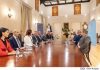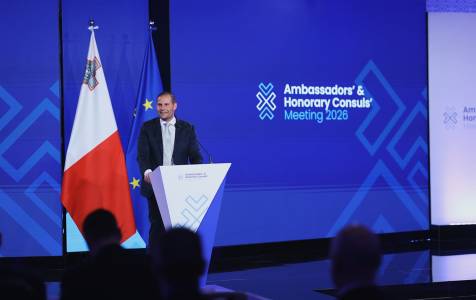
During the meeting with Ambassadors for Malta abroad, Prime Minister Robert Abela noted how this annual appointment helps to put the country’s diplomatic agenda for the coming year into perspective.
He noted how last year closed an important cycle for Malta’s foreign policy. This was in reference to a cycle during which our international agenda was linked to commitments at the highest level, in the United Nations, the Organization for Security and Cooperation in Europe, and the Council of Europe.
The Prime Minister explained that this year offers an opportunity for us as a country to reflect on how we will continue to strengthen our foreign service for the good of the country and in the national interest. In this context, the theme “Securing Our Purpose” was chosen, which emphasizes this need.
Dr Abela also referred to the Malta 2050 Vision, which looks at the future we want to build as a country. He emphasised that Ambassadors play a crucial role in making this national vision a success. Together with the Honorary Consuls, who joined this year for this meeting, they are called upon to deliver a clear message, that Malta is open to the world, built on work, and determined to seize opportunities in valuable sectors.
The Prime Minister explained how diplomatic work abroad is closely linked to the national work being carried out through the Malta 2050 Vision, particularly in pillars such as trade and tourism. He described Ambassadors as the key that opens Malta to the world.
Regarding the international context, the Prime Minister warned of challenges and uncertainties, as well as the need for reforms in multilateral institutions, especially for the protection of small countries. “We are experiencing a context of challenges and uncertainties around us. Within multilateral institutions, we are seeing the need for reforms that are not taking place, to the danger of small countries like ours. These are realities that we cannot ignore,” the Prime Minister reiterated. He added that in recent years, Malta has also shown that it is capable of making its contribution to improving these circumstances, in favour of national interests but also in favour of the common good.
“We did this when, together with several other countries, we recognised the State of Palestine, in order to keep hope alive for a Two-State Solution. We did this when we contributed to the continued functioning of the Organisation for Security and Cooperation in Europe. We did this during the Presidency of the Council of Europe, where we worked to establish the Special Tribunal for the Crime of Aggression against Ukraine,” said Dr Abela.
Now, said the Prime Minister, we are continuing to think about how Malta can be effective in its own region, the Mediterranean. Historically, the Mediterranean has fallen victim to interests that were not necessarily Mediterranean interests, even if they perhaps coincided with the interests of one or another country in the Mediterranean. Therefore, it is necessary that, in the Mediterranean region, we continue to develop our capacities to come up with truly Mediterranean solutions to the problems that affect us all.
He also mentioned Malta’s contribution at an international level and its increasingly important role in the Mediterranean, with an emphasis on challenges such as climate change and maritime security.
Dr Abela concluded by expressing his and the Government’s appreciation to the entire Diplomatic Service for its important role in the continuous development of our country.
Deputy Prime Minister and Minister for Foreign Affairs and Tourism, Ian Borg, thanked Malta’s ambassadors for their dedication over the years, in particular for the efforts they have made through their bilateral and multilateral roles during Malta’s term on the United Nations Security Council, the OSCE Chairmanship in 2024, and the Presidency of the Council of Europe in 2025.
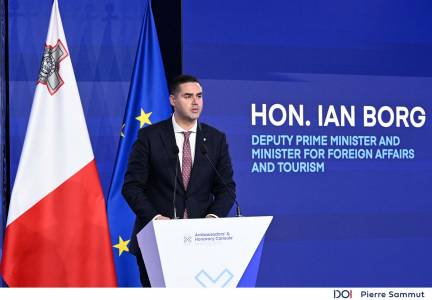
“In times of rapid geopolitical change, we must build on the multilateral achievements of recent years, while adapting wisely to remain relevant and effectively address shared challenges, without forgetting our principles, goals and unique identity,” said Dr Borg.
Photos: OPM–DOI