The Global Centre for Maritime Sanctions Monitoring (GCMSM), established in Valletta last year, is continuing to expand its worldwide maritime surveillance and monitoring capabilities with new equipment and AI-powered technologies.
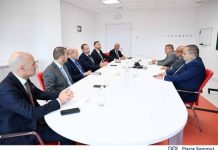
Deputy Prime Minister and Minister for Foreign Affairs and Tourism Ian Borg visited the Global Centre for Maritime Sanctions Monitoring, where he was briefed on the Centre’s expanding capabilities and its growing international role in strengthening maritime sanctions compliance and transnational crime at sea.
Dr Borg viewed recently installed state-of-the-art equipment, funded by the European Union, which significantly enhances the Centre’s ability to monitor maritime activity, analyse complex shipping data and support different jurisdictions in the effective implementation of international sanctions regimes. This new infrastructure enables real-time monitoring and advanced risk assessment processes.
The Deputy Prime Minister commended the work being carried out by the GCMSM team. “The Centre’s rapid development into a recognised international hub for supporting maritime governance, less than a year since it was set up, is truly remarkable. Malta will continue working with the Centre’s international partners, including the United Nations and the European Union, to strengthen its role in fostering dialogue, cooperation, and information-sharing among key global stakeholders, ensuring maritime safety and security,” he said.
The Ministry for Foreign Affairs and Tourism’s Director General for Global Issues, International Development and Economic Affairs, Neville Aquilina, who also serves as co-chair of the Centre’s Executive Committee, explained that as the sixth-largest ship registry in the world, Malta is actively supporting this Global Centre, reinforcing its commitment to rule of law and security at sea. “The centre works with more than 200 partners across all the five continents, in addition to ship registries and other key stakeholders. As the sole organisation of its kind globally, it bolsters Malta’s reputation as a reliable and leading jurisdiction in this crucial industry,” he added.
The Deputy Prime Minister was shown around the facilities by the Centre’s Director, Martin Cauchi Inglott, who also leads the European Union’s Critical Maritime Routes (CRIMARIO) Project, strengthening information sharing, interoperability, and maritime domain awareness among partner countries and organisations worldwide.
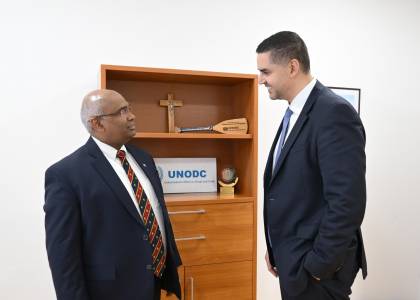
Established by Malta in partnership with Antigua and Barbuda, the GCMSM’s institutional framework was further strengthened with the signing of a Host Country Agreement with the United Nations Office on Drugs and Crime (UNODC) in June last year, enabling the co-location of a UNODC office to support technical assistance, training, and capacity-building for global maritime administrations. During his visit to the Centre, Dr Borg also met with the Head of the UNODC Office in Malta, Shanaka Jayasekara, who has been instrumental in leading capacity-building initiatives and delivering expert technical support to enhance the Centre’s work.
In December, the GCMSM and the UNODC Office in Malta hosted a landmark meeting of representatives from the world’s ship registries, with the support of the EU-funded MUSE Project. The meeting was widely regarded as a significant step towards enhanced coordination, transparency, and shared responsibility across the global maritime sector.
Deputy Prime Minister Borg was also briefed on preparations for the Conference of Global Maritime Centres, scheduled to take place in Valletta in March. This conference will further strengthen collaboration among maritime fusion centres worldwide, promote best practices, and reinforce collective efforts to uphold international maritime law and sanctions compliance at sea, cementing Valletta’s role as a leading hub for global maritime cooperation, maritime sanctions implementation and knowledge sharing.
Photo: MFT