The Valletta-based Global Centre for Maritime Sanctions Monitoring (GCMSM), in partnership with the United Nations Office on Drugs and Crime (UNODC), is convening the First Meeting of Shipping Registry Compliance Officers, in Malta, this week.
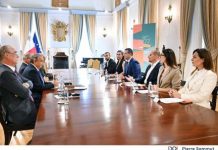
Deputy Prime Minister and Minister for Foreign Affairs and Tourism Ian Borg and Minister for Transport, Infrastructure and Public Works Chris Bonett opened the meeting, in Floriana, on Monday morning.
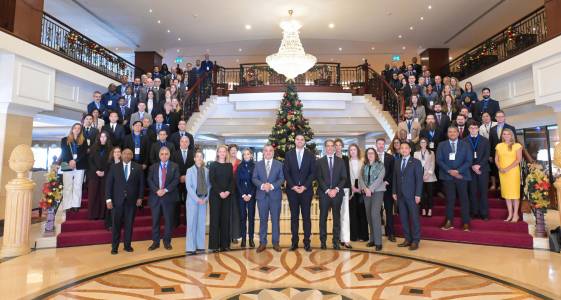
The event is bringing together compliance officers and registry authorities from 37 countries, as well as UN experts, EU representatives, and maritime governance specialists, to strengthen collective efforts in implementing UN Security Council sanctions in the maritime industry. Participants are examining systemic vulnerabilities in global shipping registries, including abrupt reflagging, insufficient due diligence, opaque ownership structures, inadequate vessel-history checks, and limited monitoring of high-risk behaviour at sea. Such weaknesses create opportunities for sanctions evasion and undermine the integrity of the rules-based maritime system.
Deputy Prime Minister Ian Borg noted that as a maritime nation with the sixth largest ship registry in the world, Malta is committed to the promotion of responsible, transparent, and law-abiding shipping practices, ensuring that its flag is not exploited, and that global maritime governance is strengthened.
“This week’s meeting reaffirms the need for coordinated, multilateral action to address structural vulnerabilities in maritime sanctions compliance. The stability of the global maritime system rests on our collective vigilance. Fragmentation empowers those who operate in the shadows, while cooperation restricts their room to manoeuvre,” Dr Borg stated.
Minister Chris Bonett said that ship registries should work together to align their approach, not by imposing uniformity, but by reducing the vulnerabilities created when systems diverge too widely. “Recent developments in global shipping have shown that no registry can operate in isolation. Fragmented compliance practices create vulnerabilities that expose the entire maritime system. Malta remains committed to upholding the integrity of its register and to working with international partners to strengthen coordination, improve traceability, and close the gaps where evasion risks emerge. Reputation in this sector is a shared asset, and through greater alignment and collaboration between registries, we can safeguard the credibility of the global maritime framework,” Minister Bonett said.
Siri Bjune, Chief of Border Management at the UNODC, explained that since the commencement of the EU-funded Maritime UN Sanctions Enforcement Project (MUSE Project), UNODC now has a dedicated capability to focus on UN maritime sanctions, particularly on capacity building with Shipping Registries. The MUSE project will work in close partnership with the GCMSM in Malta.
This week’s international meeting is also an opportunity for the GCMSM, which was established in Malta earlier this year, to foster greater inter-registry cooperation. This Centre is working to raise global due diligence standards for ship registration, background verification, and beneficial ownership checks, and to establish a global information-sharing mechanism to prevent vessels removed for misconduct from reappearing under different flags. It is also developing a shared reference system for high-risk and deregistered vessels to support informed and consistent registry decisions.
The meeting will also be addressed by senior UNODC officials, representatives from the European Commission’s Foreign Policy Instruments (FPI), and the leadership of the GCMSM.
Photo: MFT-MTIP/DOI